|
E-Newsletter • December 2025 |
▼ ADVERTISEMENT

Editor's E-Note
As is the case with the aging body, skin aging comes with its own complications. Various changes take place beneath the skin as it ages, losing its elasticity. While skin health should be emphasized at all stages of life, it’s crucial that older adults maintain the health of their skin to prevent chronic wounds and the various associated ailments. This month’s exclusive dives into a new study aimed at restoring microvascular function in aging skin, which is crucial in preventing the aforementioned wounds.
In addition to reading our e-newsletter, be sure to visit Today’s Geriatric Medicine’s website at www.TodaysGeriatricMedicine.com, where you’ll find news and information that’s relevant and reliable. We welcome your feedback at TGMeditor@gvpub.com. Follow Today’s Geriatric Medicine on Facebook and X, formerly known as Twitter, too.
— Josh Hildebrand, editor |
|
|
|
|
▼ ADVERTISEMENT

Restoring Youthful Microvascular Function to Aging Skin
The New York University School of Medicine and collaborators found that capillary-associated macrophages (CAMs) in skin decline with age, weakening microvascular repair and reducing perfusion in mice, with skin restoration possible after boosting local macrophage renewal with a growth factor treatment.
Aging of Capillary Niches
Macrophages occupy distinct tissue niches that coordinate repair and function. Previous studies have linked age-related decline in the density of capillaries to conditions including chronic wounds and neurodegeneration.
Skin hosts multiple resident macrophage populations across the epidermis, upper dermis, and lower dermis. Capillary networks in the superficial plexus support nutrient delivery to the epidermis, and prior work has associated microvascular rarefaction with aging across organs. Niche-level immune organization related to aging skin has remained unclear.
Study Design and Goals
In the study, "Niche-Specific Dermal Macrophage Loss Promotes Skin Capillary Ageing," published in Nature, researchers used intravital two-photon microscopy and complementary mouse genetics to determine how CAMs organize, renew, and sustain capillary function during physiological aging.
|
Shingles Vaccine Could Slow Dementia
A vaccine rollout in Wales led to the discovery that the shingles vaccine reduces dementia among older adults who received it. Those with dementia also saw benefits that warrant further testing, according to Stanford Medicine.
Lower Visceral Fat Linked to Healthier Brain
Researchers in the Department of Radiology at Mallinckrodt Institute of Radiology at Washington University School of Medicine in St Louis found that people with lower visceral fat and more muscle have “younger biological brain age.” Their research was presented at the annual RSNA meeting.
Friendships May Slow Aging
Social isolation is well-known for being detrimental to older adults. A new study out of Cornell University found that social support can “slow biological aging.” Their research can be found in the journal Brain, Behavior, and Immunity - Health.
Untreated Sleep Apnea Could be Connected to Risk of Parkinson’s
The likelihood of developing Parkinson’s increases in those with untreated obstructive sleep apnea. Research found that the restriction of oxygen damages neurons over time. Their research is published in JAMA Neurology. |
Isaac Health In-Home Memory Clinic
As the number of new dementia patients increases, Isaac Health, a brain health and dementia care platform, aims to close the gaps in care and provide timely diagnosis and treatment. The company offers virtual and in-home care services to individuals with Alzheimer’s disease, dementia, memory loss, aphasia, and other forms of cognitive impairment. Isaac Health is available in all 50 states and is covered by insurance, including Medicare. Learn more » |
|
|
COVER STORY
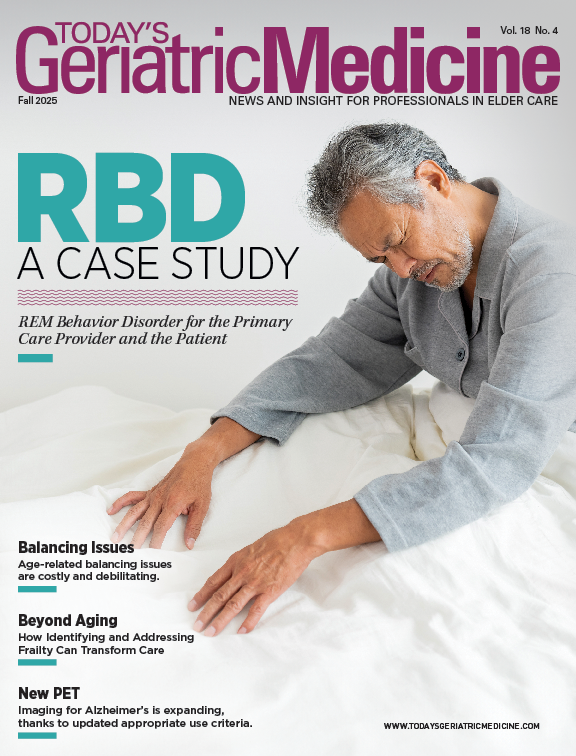
RBD: A Case Study
Older adults suffering from rapid eye movement behavior disorder act out their dreams, which can lead to injuring their bed partner. Gerontologists are working to destigmatize the disorder and help primary care physicians better understand how to treat it.
FEATURE
Balancing Issues
Balancing issues affect many older adults. Despite this, these issues are often hard to diagnose and harder to treat. Thanks to emerging technology, balancing issues may be a thing of the past.
|
|
|
| Advertising Opportunities |
Have a product or service you want to market to geriatric care professionals? Utilize the reach of Today's Geriatric Medicine Magazine to accomplish your marketing goals. Email our experienced account executives today at sales@gvpub.com or call 800-278-4400 for more information.
|
| © 2025 Today's Geriatric Medicine Magazine |
|
|